
Remnant Planetary Systems
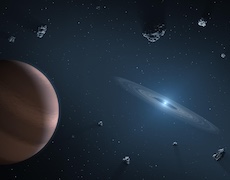 Massive white dwarfs (0.8–1.3 M⊙) provide a unique way
to constrain planetary occurrence around intermediate mass main sequence stars (4–8 M⊙) that are otherwise difficult to measure
with radial-velocity or transit surveys.
During my Ph.D., I found that planets seem to be missing around the descendants of intermediate-mass main sequence stars (A-B type). While over 40% of white dwarfs harbor remnant planetary systems, HST/COS spectra reveal that far fewer massive white dwarfs exhibit pollution from heavy elements (Ould Rouis et al. 2024). I then explored the use of extremely-low-resolution Gaia XP spectra in order to build a larger sample of these rare planet hosts (Ould Rouis et al. 2026b). I've also identified hundreds of new white dwarf planetary hosts candidates with narrow-band photometry from the MAGIC survey within the DELVE collaboration (Ould Rouis et al. 2026c,in prep.).
Stellar Mergers
I have also been interested in the progenitor history of massive white dwarfs specifically tied to merger signatures, and recently completed a volume-limited study of merger remnants with high cooling delays on what is known as the Q branch, finding distinct populations in magnetism and photometric variability (Ould Rouis et al. 2026a). This work also extended the DAV instability strip for hydrogen-dominated, DAQ white dwarfs.
Galactic Archaeology
I am interested in linking the kinematics of white dwarfs to Galactic locations, specifically being able to characterize halo white dwarfs and trace their origins to different halo substructures Through a close collaboration with Dr. Laura Rogers (NSF-NOIRLab Fellow), we use HST observations of halo white dwarf candidates to investigate the frequency of remnant planetary systems in the halo compared with the thin disk (Rogers et al. in prep., Ould Rouis et al. in prep.).
Publications
You can find my full publication record on NASA ADS and on my CV.